Pioneering AI hardware & intelligent systems.
Undergraduate researcher at BITS Pilani, exploring the broader frontiers of AI Hardware, open to all emerging compute paradigms, with current active research in the applications layer of neuromorphic computing at the Nanoscale Devices Lab (NSDL) under CREST, advised by Dr. Parikshit Sahatiya. Previously engineered ML anomaly detection for BBM92 QKD during a research internship at SSPL, DRDO.
Evaluation benchmark for free-space BBM92 quantum key distribution under simulated atmospheric turbulence and hierarchical threat models. Demonstrates how 22-dimensional temporal cross-channel features identify stealthy, sub-threshold eavesdropping attacks that evade conventional static QBER threshold detection.
Temporal Cross-Channel Features for Eavesdropping Detection in Free-Space BBM92 QKD under Hierarchical Threat Models
This work investigates machine-learning-based eavesdropping detection for free-space BBM92 quantum key distribution under realistic atmospheric noise and hierarchical threat models. The study moves beyond conventional static QBER thresholding by exploiting temporal and cross-channel relationships between quantum observables, enabling detection of stealthy attacks designed to remain below conventional security thresholds.
The work develops a physics-informed temporal feature framework that captures correlations and temporal signatures across QKD telemetry, with particular emphasis on identifying eavesdropping activity masked by naturally occurring atmospheric fluctuations. The resulting approach provides a more sensitive and interpretable mechanism for monitoring the security of free-space quantum communication links.
Physics-Aware Temporal Feature Engineering for Eavesdropping Detection in BBM92 Quantum Key Distribution
This preprint proposes a physics-aware temporal feature engineering framework for detecting eavesdropping in entanglement-based BBM92 quantum key distribution systems operating over noisy free-space optical channels. The work addresses a limitation of conventional static QBER thresholding: an attacker can potentially hide low-intensity attacks within naturally occurring atmospheric fluctuations. A 24-dimensional feature space is constructed from QBER, the Bell S parameter, photon coincidence rates, detector activity, HOM visibility, and optical path loss over a 30-second sliding window. On a simulated 24-hour free-space optical telemetry dataset evaluated across five random seeds, conventional QBER thresholding achieved 17.3% recall against blended sub-threshold attacks, while an XGBoost classifier using the proposed features achieved 96.9% recall and 97.6% precision. SHAP analysis indicated that detection of stealthy attacks was driven primarily by anomalous temporal cross-correlations between independent quantum observables rather than simply elevated QBER.
| Metric | Static QBER Threshold | Proposed XGBoost Model |
|---|---|---|
| Recall | 17.3% | 96.9% |
| Precision | 100% | 97.6% |
| F2 Score | 20.7% | 97.0% |
Nanoscale Devices Lab (NSDL)
Conducting research under the supervision of Dr. Parikshit Sahatiya at the Nanoscale Devices Lab (NSDL), under the Centre for Research Excellence in Semiconductor Technologies (CREST). While open to all emerging domains across the broader AI Hardware spectrum, my active lab research centers on the applications layer of neuromorphic computing, spiking dynamics, and low-latency edge intelligence, grounded in prior physical telemetry and ML foundations from SSPL, DRDO.
Applied Neuromorphic Computing & Event-Driven AI Hardware
Investigating application-layer implementations of neuromorphic AI hardware architectures at NSDL (CREST) under Dr. Parikshit Sahatiya. Focusing on event-based data representations, low-latency streaming inference, and temporal processing models.
Emerging AI Hardware Paradigms & Spiking Dynamics
Exploring algorithmic models that exploit temporal sparsity and spike timing for efficient real-time anomaly detection and signal classification in constrained edge hardware environments.
Physical Telemetry & High-Dimensional Sensor Fusion
Leveraging foundational experience from physical sensor telemetry to develop robust, noise-resilient machine learning pipelines that translate complex multi-channel hardware signals into actionable diagnostics.
Entanglement-Based Free-Space QKD Eavesdropping Monitor
A physics-aware temporal feature engineering and anomaly detection pipeline for free-space BBM92 quantum key distribution links. Developed during an 8-week research internship at the Solid State Physics Laboratory (SSPL), DRDO under Dr. Lalit Kumar (Scientist F) and Dr. Vikhen Kumar (Scientist E). Includes an optical channel physics simulator, four attack models, a 22-dimensional temporal feature vector over 30-second sliding windows, XGBoost with SHAP interpretability, and a live Streamlit dashboard explaining alerts.
Indian Equity Portfolio Optimizer
Full-stack quantitative finance tool implementing Modern Portfolio Theory (MPT) to optimize Indian stock portfolios. Dynamically processes National Stock Exchange (NSE) tickers, computes efficient frontiers using quadratic programming, and supports target-return constrained optimization under real-time market data.
Cardiovascular Disease Risk Prediction Model
Supervised machine learning classification pipeline achieving 86.67% test accuracy in predicting patient cardiovascular risk. Employs comprehensive feature engineering, clinical attribute correlation, and stratified k-fold cross-validation to prevent overfitting in medical risk triage.
“True security in physical channels emerges not from arbitrary thresholds, but from deciphering the temporal physics of the medium.”
I am Saksham Gupta, an undergraduate engineer in the Department of Electrical & Electronics Engineering at BITS Pilani, Hyderabad Campus.
My overarching research interest is in AI Hardware, exploring how emerging physical architectures, novel compute substrates, and specialized hardware accelerators can redefine machine intelligence. While I am open to all domains across AI hardware, my current active research focuses on the applications layer of neuromorphic computing at the Nanoscale Devices Lab (NSDL) under the Centre for Research Excellence in Semiconductor Technologies (CREST), supervised by Dr. Parikshit Sahatiya.
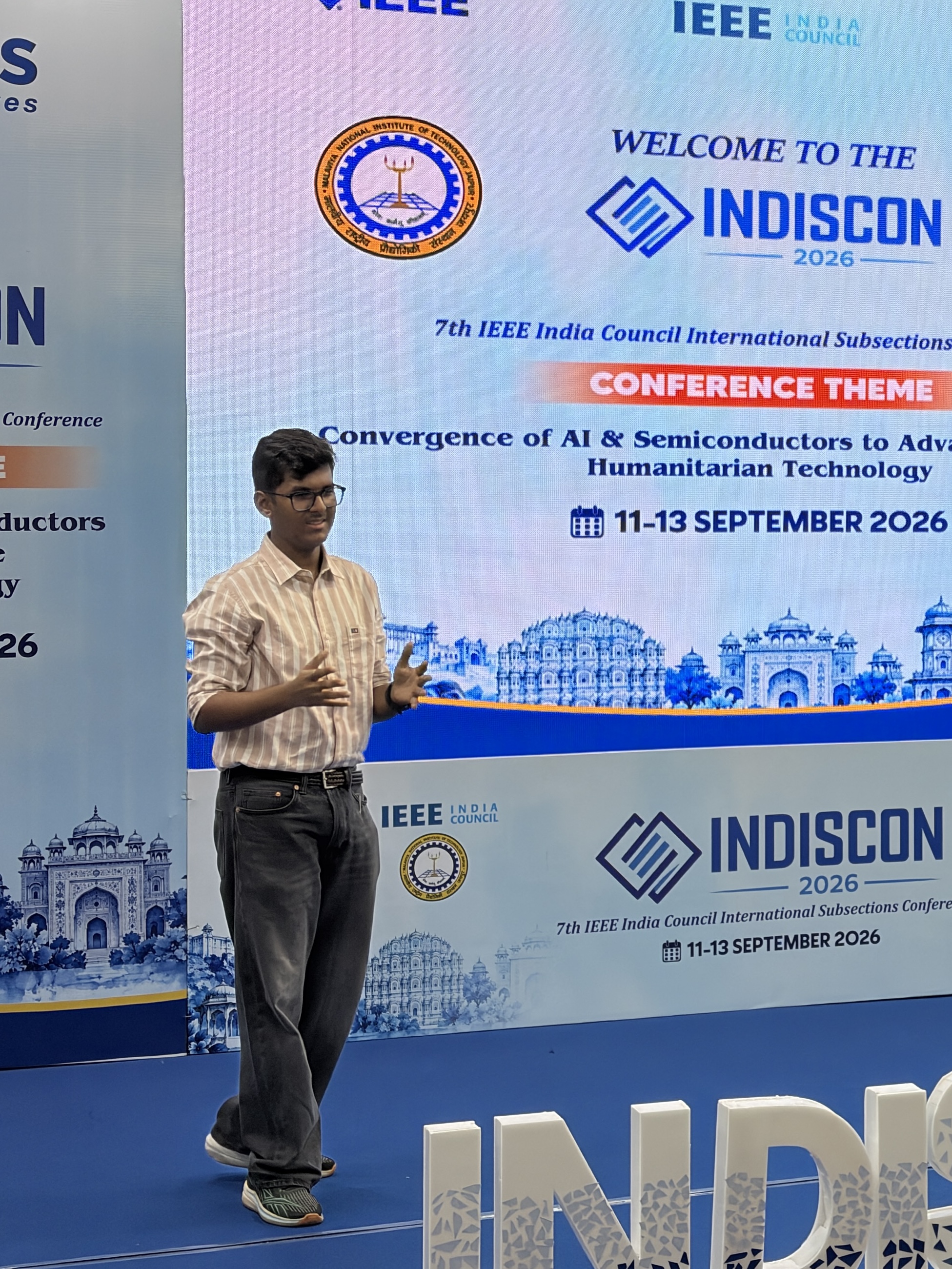
Prior to this, I completed an 8-week research internship at the Solid State Physics Laboratory (SSPL), DRDO under Dr. Lalit Kumar (Scientist F) and Dr. Vikhen Kumar (Scientist E). There, I built a real-time anomaly detection pipeline and temporal cross-channel ML framework for free-space BBM92 Quantum Key Distribution, research resulting in an accepted paper at IEEE INDISCON 2026.
On campus, I contribute to the Quantum Computing & Machine Learning Team at the IEEE Student Branch and the Machine Learning Team at the ACM BPHC Chapter.
Undergraduate Researcher · NSDL @ CREST
Focusing broadly on AI hardware and intelligent physical systems, with current active research in the applications layer of neuromorphic computing, event-driven temporal architectures, and edge sensing at the Nanoscale Devices Lab (NSDL) under CREST.
Research Intern · Solid State Physics Laboratory (SSPL)
Selected as one of the few first-year engineering students for a research internship at a national defence R&D institution. Built a real-time anomaly detection system for entanglement-based Quantum Key Distribution (BBM92) under Dr. Lalit Kumar (Scientist F) and Dr. Vikhen Kumar (Scientist E): developed an optical channel physics simulator, four attack models, a temporal ML pipeline, and an explainable live dashboard.
Quantum Computing & Machine Learning Team
Active member of the Quantum Computing & ML Team, working on technical projects, quantum algorithms, and specialized computing workshops for the student community.
Machine Learning Team
Contributing to research-driven machine learning initiatives and organizing technical computing workshops across campus.
B.E. Electrical & Electronics Engineering
Rigorous coursework across Microelectronics, Digital Signal Processing, Machine Learning, Circuit Analysis, and Computer Programming.
Let's build something resonant.
I welcome academic inquiries regarding my accepted paper at IEEE INDISCON 2026, collaborative research across AI hardware architectures, applied neuromorphic systems, or visiting student appointments.